Investing through my company: why I did it, stopped, and started again
Investing through your company: I did it with mine, I stopped, and recently I started again. I know, not exactly consistent. 😄 But trust me, there was a reason every time, and that reason always had to do with taxes.
I’ve been freelancing since 2022 through a Belgian CommV (a commanditaire vennootschap, a Belgian company form where the managing partner runs the business and is personally liable). How I pay myself, a regular salary plus the rest through VVPRbis, is in my post about the CommV (in Dutch, for now). This post is about the question that comes right after: what do you do with the money that stays in the company?
Why I started out investing through my company
VVPRbis is a Belgian regime that lets small companies pay out dividends at a lower withholding tax. It comes with a big catch: the low rate (low for now, at least) only applies after a waiting period of three financial years (Wolters Kluwer lists the rules, in Dutch). Pay out profits earlier as a normal dividend and you pay 30% withholding tax. So for the first years, the money stayed in the company. And letting it sleep on a current account felt like a waste.
So I opened a securities account in the company’s name at Bank J. van Breda. Why them? It seemed smart to already be a client there in case I want to grow further as an entrepreneur later. They offered a tax-friendly investment for my company, a so-called DBI-bevek (a fund built for companies). It mostly invests in a tracker, with the bank’s own personal tilt on top.
Why I moved everything to my own name
As soon as I could pay out through VVPRbis, I had those investments transferred to my private account. That turned out to be pretty easy: one message to my banker and the order went through asap. The next day the money was on my private investment account with them, without any transfer costs. Staying at Bank J. van Breda followed the same logic as starting there with my company: building a relationship I might be able to use later to grow my business.
The reason becomes clear once you put the taxes side by side:
| Private | In the company | |
|---|---|---|
| Dividends | 30% withholding tax | Corporate tax (25% in my case), the withholding tax can be offset |
| Capital gains on shares and ETFs | 10% capital gains tax, above an exemption of €10,000 per year | 25% corporate tax, unless you own at least 10% of a company or invest €2.5 million |
| Capital losses on shares | Only deductible from gains in the same year | In principle not deductible |
| Getting the money into your own pocket | It already is | Another 18% through VVPRbis |
Sources: KPMG for the capital gains tax, Lemon Consult for the company side (both in Dutch).
A worked example
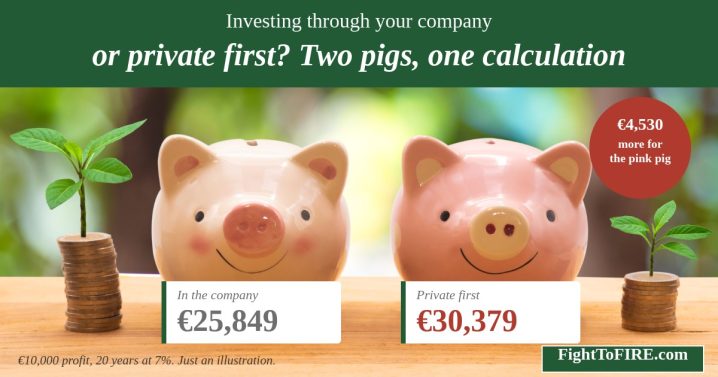
Say €10,000 of profit sits in the company, already taxed by corporate tax. I invest it for 20 years in an ETF that returns 7% a year and sell everything in one go. (It’s an illustration. Nobody knows what the next 20 years will bring.)
| In the company | Private first (VVPRbis) | |
|---|---|---|
| Starting amount | €10,000 | €8,200 |
| After 20 years at 7% | €38,697 | €31,732 |
| Tax on the gain | 25% on €28,697 = €7,174 | 10% on (€23,532 – €10,000) = €1,353 |
| Still to take out of the company | 18% VVPRbis = €5,674 | Not needed |
| In my pocket | €25,849 | €30,379 |
Inside the company you start with more money, because the 18% hasn’t been paid yet. You still lose that head start by a wide margin, because every euro of gain pays 25% tax. Even at the reduced corporate rate of 20%, private comes out ahead in this example.
And the DBI-bevek, for years the banks’ standard answer to investing through a company? Since 2026 you only get the withholding tax on those dividends back if at least one director earns €51,000 (SBB, in Dutch). I deliberately stay below that, so for me it’s not that interesting anymore.
Why I’m investing through my company again anyway
After that table you’d think: never again. And yet I recently invested part of the money in the company again. Not very surprising, really: it’s pretty much the same reason I started in the first place. Keeping that relationship for (possibly) better terms on other things. It’s also a long-term buffer, because money inside the company is harder for me to touch.
What I do know for sure: money the company will need itself later never has to come out. For that part the 18% disappears, and the math looks different. Money that has to end up in my own pocket someday, I’d rather invest privately from now on.
I’m not an accountant, so read this as “what I did and why”. If you’re thinking about investing through your company, have your own situation checked, especially with bigger amounts.
Do you invest through your company or take everything out? I’m curious what your accountant thinks about it.