Robo Investing in Belgium in 2026: Innovative Evolution or Bland Banking Facelift?
When I first wrote about robo investing in Belgium in early 2022, nine providers were in the market and competed for that sweet retail cash. I looked at them all, compared fees, read the fine print, and then did absolutely nothing with it. Never opened an account, didn’t bother with any of them but rather chose to stick entirely to my DIY setup.
Now, four years later, I’m revisiting the topic. As it turns out, more than half of the providers from my original overview are gone. The ones that survived now tell an interesting story about what (Belgian) investors actually want. My view on whether robo investing makes sense for a FIRE investor hasn’t changed much, but the reasons why did.
The Great Belgian Robo-Shakeout: 2022 vs. 2026
Out of the nine original providers, five have quietly pulled the plug or been entirely absorbed. That’s less than I expected honestly, but we can see an interesting development. Crucially, every single bank-owned or bank-backed retail robo product launched during the “digital innovation craze” has either dissolved or significantly rolled back its offerings. The independent fintechs are the ones left standing.
To save you from jumping back and forth between old spreadsheets, here is the ultimate, definitive status report of the Belgian robo-investing landscape:
| Provider | 2026 operational status | Annual management fee | Min. deposit | Core distinction | 2026 traits |
|---|---|---|---|---|---|
| Curvo | Active (Market Leader) | 0.6% – 1% | €50 | TOB Exempt | Automated Fractional Shares |
| Indexa Capital | Active (New Entrant) | 0.4% – 0.85% | €2,000 | Lowest Cost | French & Spanish Platform Only |
| Easyvest | Active (Independent) | 0.4% – 1% | €5,000 | Targeted B2B & Self-Employed Niche | – |
| Keytrade KeyPrivate | Active (Traditional) | 0.91% | €15,000 | Active rebalancing committee | High entry |
| MeDirect MeManaged | Active (Traditional) | 0.90% (flat) | €5,000 | Relaunched using standard BlackRock funds | Yes |
| Matti by Bolero (KBC) | CLOSED (April 2024) | – | – | Accounts forcefully converted to standard Bolero | – |
| Birdee (BNP Paribas) | CLOSED (June 2025) | – | – | All positions liquidated; cash returned to users | – |
| Lucy (BNP Fortis) | CLOSED (Late 2025) | – | – | Quietly discontinued alongside Birdee | – |
| ETFMatic (Aion Bank) | ABSORBED | – | – | Bought by Finax for proprietary white-label B2B tech | – |
| Dexxi (Indexus) | WOUND DOWN | – | – | Acquired by Semmie Groep | Faces Dutch AFM prosecution |
| BinckBank Laten Beleggen | DISCONTINUED | – | – | Eradicated following the Saxo Bank migration | – |
The Illusion of the “Banking Facelift”
First, the robo graveyard:
- Matti by Bolero (KBC): Closed in April 2024. KBC quietly pulled the plug on their “intelligent investment assistant” after four years. Customers had their ETFs forcefully transferred to a regular Bolero account.
- Birdee (BNP Paribas): Closed in June 2025. Originally created by fintech Gambit and later acquired by BNP Paribas Asset Management, BNP liquidated all investments and returned the raw cash to customers. Curvo wrote a transition guide for displaced Birdee users.
- Lucy (BNP Paribas Fortis) Discontinued in late 2025. Unlike its highly marketed launch, it was quietly phased out alongside the Birdee shutdown.
- Aion Bank ETFMatic: Absorbed. Aion moved away from retail investment products entirely. Slovakian fintech Finax acquired ETFMatic for its Investment-as-a-Service (IaaS) tech, merging the retail platform into their own.
- Dexxi (Indexus): Wound down following a takeover by Semmie Groep; which is now being prosecuted by the Dutch Authority for the Financial Markets (AFM) for misleading investors.
- BinckBank ‘Laten Beleggen’: Discontinued during the migration to Saxo Bank; the robo portfolio tier did not survive the transition.
The Corporate Experiments That Failed
The death of the banking advisors like Matti and Lucy shouldn’t be skipped over. It shows exactly how traditional Banks view digital product development. Let’s take them as an example.
For instance, De Tijd reported in April 2024 that former Matti users found the robot’s investment choices “sometimes incomprehensible” and that returns were generally mediocre. KBC refused to share how many customers it had or how much was invested. When they pulled the plug, they redirected users to “Kate”, KBC’s AI assistant, and to actively managed KBC funds with higher fees than Matti had charged. A seamless transition for the bank’s fee income, less so for the investor.
BNP Paribas Fortis was equally candid about Lucy: “Our robo advisor Lucy was a sort of laboratory in which we learned a lot.” That is polished corporate speak to say it failed to make money. They cited stricter regulations making Lucy “too cumbersome”, though given the timing it reads more like a convenient exit as they handle heavy compliance daily.
It’s funny to look at their post that launched the product:
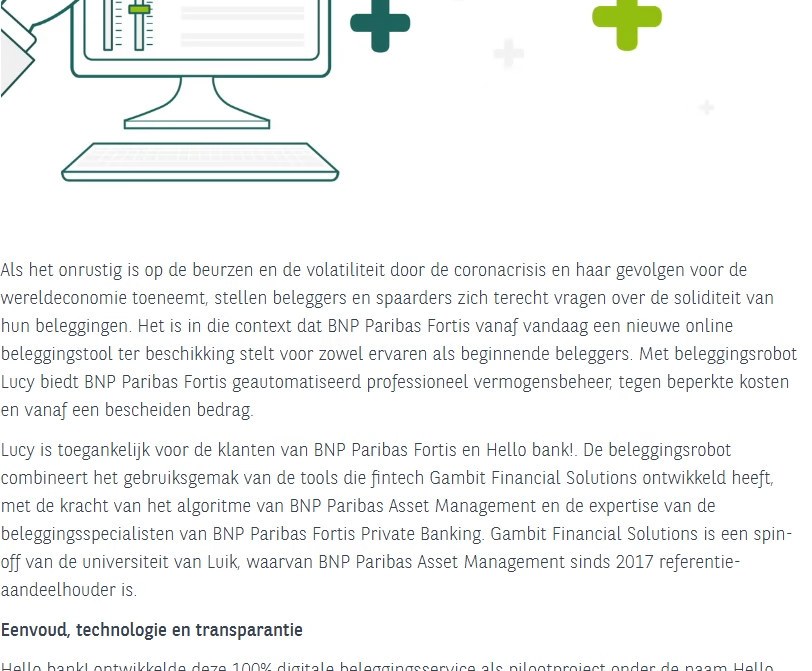
The underlying problem wasn’t the regulation for banks, they have a lot of that and can still do business just fine. These products were basic digital wrappers designed to lock assets inside their ecosystems, tick an internal “digital transformation” box, and capture easy fee revenue. When they failed to attract meaningful assets, there was no reason to keep funding them.
Why the Independent Fintechs Survived
Independent platforms like Curvo and Easyvest survived because they had no corporate safety net to absorb losses. That existential pressure forced them to innovate:
- Curvo’s Regulatory Shortcut: To sidestep the millions in capital required to build a licensed investment infrastructure, Curvo lean-bootstrapped by partnering with Dutch investment firm NNEK. NNEK absorbs the operational regulatory weight, freeing Curvo to focus strictly on a seamless user experience. They targeted the structural barriers keeping young savers out of the market by offering an automated €50 minimum deposit paired with fractional share investing. These are features traditional banks simply couldn’t (or wouldn’t?) support.
- Easyvest’s Institutional Pivot: Easyvest decided on a different approach. They moved away from fighting over low-margin retail accounts. Instead, they focused heavily on business owners, freelancing professionals, and corporate asset allocation. This culminated in Easyvest launching an institutional pension fund (OFP), allowing them to lock down a massive €13 million funding round backed by Belfius Insurance and the Belgian state’s federal investment fund (SFPIM).
Traditional banks treated robo-advising as a temporary marketing experiment the smaller players treated it as their core business and maybe even pure survival instinct.
Let’s take a closer look at the remaining robo advisors
Curvo

Curvo has become the dominant name in Belgian robo investing scene. A Belgian engineer frustrated with the complexity of DIY investing built it around 2019–2020, and it’s now the go-to recommendation in Belgian FIRE and personal finance circles. The €50 minimum and automated monthly investing make it accessible to pretty much anyone, and the TOB exemption is a practical win. Fees run from 1% on amounts below €50,000 down to 0.6% above €250,000.
The downside: you have no say in what you invest in. The portfolio is chosen for you, and you can’t change it. For a hands-off investor, that’s the whole point. For someone who’s already formed views on ETF allocation, it’s probably a bit limiting.
Indexa Capital

A Spanish robo advisor with Belgian roots, one of the founders is Belgian, and they expanded here from Spain. They’re the cheapest option in the current market at 0.4% to 0.85%, with a minimum of €2,000. The catch is that the platform is still only available in French or Spanish. For Flemish investors, that’s a real problem.
Easyvest
The original Belgian robo-advisor remains fully independent, though Belfius secured a minority stake in 2024. They lean heavily toward wealthier clients, a strategy made obvious by their €5,000 investment minimum. While management fees scale down competitively for larger balances, they have successfully captured a lucrative niche by offering custom corporate asset management and fiscal optimization frameworks specifically tailored to freelancers, sole proprietors, and small business owners.
MeDirect MeManaged

MeDirect recently overhauled their managed portfolio tier as MeManaged. The setup relies on four distinct allocation risk paths built exclusively using BlackRock and iShares underlying funds. While the platform previously carried a staggering 1.3% flat cost, they have scaled the internal management fee back to a flat 0.90% (including VAT) with an initial investment floor of €5,000. It sits right in the middle of the pricing pack, but still struggles to beat the cheaper independent index options.
One New Complication as of 2026: Capital Gains Tax
This regulatory hurdle simply did not exist when I published the original version of this market review.
Concretely, Belgium introduced a capital gains tax at the end of 2025, which went into effect on January 1, 2026. The legislation imposes a fixed 10% tax on realized investment gains above a set personal threshold. Fortunately, a standard two-person household receives a combined €20,000 exemption limit, which cushions the blow for everyday retail investors.
It doesn’t completely change the picture, it introduces an advantage for active robo-advisors. Because the algorithm executes internal portfolio rebalancing automatically behind the scenes, it shifts assets without forcing you to manually trigger taxable reporting events.
Beyond that, the native transaction tax (TOB) exemptions carried by platforms like Curvo and Indexa Capital take the manual operational labor out of investing. They eliminate the hassle of calculating, recording, and physically declaring transaction taxes to the Belgian state every month.
The FIRE Mathematics: Fee Drag vs. Behavioral paralysis
Despite the technical convenience, the wealth-building reality of broad index investing through ETFs remains bound to simple maths.
The trade-off is clear to me: you are paying an extra 0.6% to 1.3% per year in management fees on top of the underlying ETF expenses in exchange for not having to think about any of it. For a FIRE investor with a 20-to-30-year horizon, that fee acts as a massive anchor on compounding growth. On a foundational €100,000 portfolio, a 1% annual drag means €1,000 every single year is stripped away instead of compounding into retirement capital.
[DIY Portfolio: 100% Compounding] ──> (Retire Wealthier)
[Robo Portfolio: Fee Drag Anchor] ──> (Loss of Long-Term Wealth)
In contrast, buying VWCE or IWDA through a broker like Bolero or DEGIRO really isn’t that complicated once you’ve done it once. Just like in Curvo you log into an interface, execute a couple of basic inputs, and walk away. Learning the underlying tax structures and setting up a recurring monthly buy allows you to keep 100% of those compounding gains. Over a 20 or 30 years investment career, those saved management fees add up to a first-class long-haul plane ticket (and you don’t even need an Amex card to get it).
Where Robo-Investing Secures a Legitimate Win
However, there is a specific psychological scenario where robo investing makes complete financial sense: overcoming behavioral paralysis.
Even so, if you’re someone who would otherwise not invest at all because the DIY route just doesn’t scratch your itch, a 1% annual fee is a very fair price to get your money moving. Curvo’s frictionless monthly automation removes the hesitation that keeps the average person on the sidelines. In the beginning years of building wealth, the habit of consistency matters far more than fee optimization. After all, time in the market beats timing the market.Skip it if you already have a solid portfolio, consistent habits, and a clear view of what index funds you want to hold — you’d be paying a premium for a service you don’t need. Where it makes most sense is for someone brand new to investing, paralyzed by the complexity, with zero interest in learning the mechanics but who wants their money working instead of sitting in cash.
What comes after robo investing?
Robo advisors automate the boring part of the investing. But the newest marketing pitch blanketing the industry in 2026 goes a step further: Generative AI Wealth Management. It supposedly picks, times and trades for you.
Whether AI-driven portfolio construction is a genuine technological leap forward, a basic robo-advisor repackaged with a shiny modern sticker, or a surefire way to reduce your portfolio balance to zero is an absolute minefield. It completely deserves its own deep-dive post, which you can now read 😉 !
If you want it in your mailbox, the mailing list is the place to be -> *points towards the side bar, or down for mobile users *wink wink*
Let’s hear from you in the comments: Have you ever used a Belgian robo-advisor? Did you stick with it, or did you make the jump to a pure DIY broker setup?